
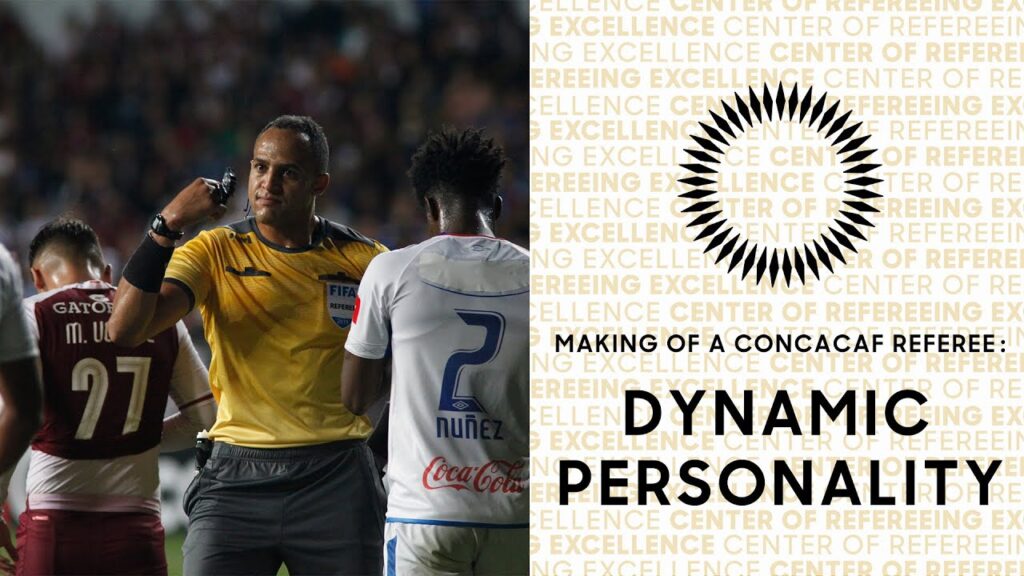
We utilize one descriptive word to encompass our vision of excellence relative to the execution of personality on and off the field of play. That all-encompassing word is: dynamic.
Think about that word: dynamic. And ask yourself, what does it mean to you? What picture do you get when you visualize a dynamic individual? Whether it be a dynamic actor, a dynamic presenter, or a dynamic leader. Once you have visualized this person, make a list of the characteristics that are part of that person’s repertoire. What is it that sets that person apart and enables them to demand your attention and connect with you?
Those are the components of a dynamic referee. Someone who can walk on the field and the players, coaches, spectators, and even those sitting at home in front of their television sets can feel their presence. And can feel the sense that that referee or assistant referee for that matter is in charge and in control even before blowing the first whistle. The aura of this referee shouts out, “I am in charge. Welcome to our house.”
Of course, this must be delivered in a positive fashion. Now let’s examine some of the specific characteristics and explore the question: “how does the dynamic personality ultimately show up on the field of play?” Consider the following four key elements or characteristics of the dynamic referee.
Remember though, when these four characteristics come together, we have you. Your image. The image that players, coaches, spectators, and media see. What are these four characteristics?
1. Refereeing tools
Use of the whistle. Use of the yellow card. Use of the red card. It’s the tone, the length, and volume of the whistle and how it can be a great audible tool that can be received by everyone.
2. Verbal
These are the words chosen and how those words are delivered. Like the tone, the volume, the inflection.
3. Facial expressions
How your eyes and mouth inflections come together to visually convey your message. This is your “game face.” A face that varies depending upon the situation. What will be more impactful? A smile or a frown? A stare or a glance? It Is important to utilize one-on-one communication to effectively execute your message.
4. Body language
How you stand, how you walk, and how you run. As well as how you use your hand gestures. This is the most visual of the characteristics. And typically the one with the largest audience. It does not need verbal to be effective.
It is so important that your dynamic personality, exude confidence and positive authority, but there’s also just as important that it conveys compassion and empathy when the game requires it.
Lastly, I want to give you one additional food for thought: and that is referees must be actors. You must vary your personality to match the scene. In the movie or play, as in a game, there are multiple scenes. And the actors or referees’ personality must change in order to match the requirements of that point in the movie and to connect with the audience. In our case, the audience is the players and coaches. Hence, our message must be heard from them. It must have an impact with the goal of influencing future actions of our participants.
When the scene or game requires a smile, the referee changes their personality to exhibit this quality. Later, as the intensity and the atmosphere of the game heats up, the referee changes their personality to match the needs of the game and to send inappropriate message that will resonate with the audience.
The smile probably doesn’t match the needs of the game at this time, but possibly the stern look, a more intense voice, or more demonstrative body language are the solutions. It’s always good practice to ask yourself prior to choosing your personality: what are the requirements of the scene at this moment?
In addition, remember the referee can always customize their message depending upon the personality of the player. How do you determine the personality? Well, that’s something you can ascertain early in the game based upon your interaction with the player or watching the players body language. Or you can use historical experiences with the player to help you formulate your game plan.
When determining how your dynamic personality should be delivered, you can ask yourself two questions. What does the player need at this moment? What does the gain need at this moment? These two simple questions will help the referee match their personality to the requirements of the game.
This has been a high level overview of the factors that help referees display a dynamic management style or personality. Next time you watch a game or two, forget about the decisions made by the referee. Just watch how they delivers them. How does the referee use these tools to deliver a dynamic and convincing personality?
As a referee, don’t hide behind the whistle. Don’t hide behind the yellow card or red card, even for that matter. Be an actor and transform your actions and personality to direct the outcomes of the game. Remember the referee’s personality is their greatest opportunity to influence actions in the game in a preventative and proactive manner. Use preventative refereeing to modify behavior early in the match and remember to influence the future with your actions in the present.
Do not just referee for the moment, referee for the future. Thank you and happy whistling.