

“A person is not given integrity. It results from the relentless pursuit of honesty at all times.” – Anonymous
Perhaps no other referee in history experienced the solo pursuit of honesty that Esse Baharmast faced in the 1998 FIFA World Cup in France. He faced global scrutiny for a critical decision that initially portrayed him as a villainous referee, but eventually led to his complete vindication. Now 56 years old, he serves on the CONCACAF Referees’ Committee and as a FIFA Instructor.
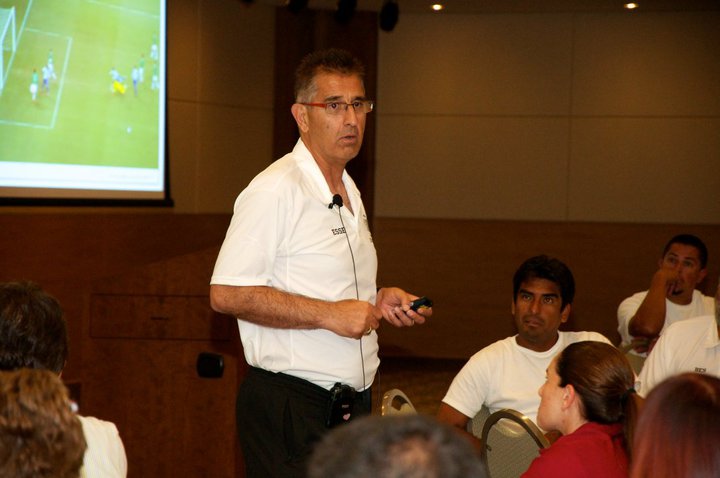
Baharmast was the keynote speaker at the Ken Aston Camp for AYSO referees on July 24, 2010. The camp is an opportunity to discuss officiating skills and the Laws of the Game with some of the most knowledgeable and experienced staff in the country. His presentation included major instruction from the 2010 FIFA World Cup in South Africa including video clips, data the FIFA Referee Committee collected, and points of emphasis that World Cup referees prepared for prior to their arrival.null

FIFA REFEREE CAREER
Baharmast grew up playing soccer in the Iranian capital of Tehran. He moved to the United States in 1972. After an injury slowed his playing career, he began to officiate soccer. He began with youth games and worked his way up with high school and college matches. Starting in 1981, he earned professional assignments and officiated in the American Professional Soccer League, the Continental Indoor Soccer League, the National Professional Soccer League, the Major Indoor Soccer League, the American Soccer League and the American Indoor Soccer Association. He became an American citizen in 1991 and had his first international-friendly assignment between the United States and Uruguay on May 5, 1991. He became a FIFA Referee in 1993.
Baharmast’s notable appointments started with the 1993 World University Games, 1994 Pan American Games, and the 1996 CONCACAF Gold Cup. He officiated the inaugural Major League Soccer game between San Jose Clash and DC United on April 6, 1996. He also officiated three games at the 1996 Olympics, becoming the only American referee to officiate an Olympic semifinal (Argentina-Portugal). He was selected as the 1997 MLS Referee of the Year and completed a trifecta of assignments with the 1997 Major League Soccer Championship, the A-League Final and the U.S. Open Final. His career continued with the 1997 U.S. Cup, 1997 Copa America and 1998 CONCACAF Gold Cup. At the 1998 FIFA World Cup in France, he became the only American referee to ever take charge of two matches at the World Cup level.

WORLD CUP INTEGRITY
Only a few international referees have a career footnote with a controversy. Baharmast’s footnote stems from the 1998 FIFA World Cup in France in a match between Brazil and Norway. In a match tied at 1-1 in the 89th minute, Baharmast was seemingly the only person in the world to witness Brazil’s Júnior Biano tug the jersey of Norway’s Tore André Flo. Flo went down in the penalty area as he awaited a crossed ball. Baharmast blew the whistle and signaled for a penalty kick.
The view on television was obscured and unclear to journalists. Television commentators and newspapers around the world were quick to judge Baharmast for calling an “imaginary penalty.” Several video replay angles did not capture the foul and added fuel to the growing fire.
In Morocco, newspaper headlines proclaimed, “Norway saved by referee.” USA Today published a column that asked: “How about sparing us from all inept referees?” Both the London Times and the International Herald-Tribune suggested an American did not have the experience for an important game.
Baharmast told journalists: “I was only about six yards away, looking straight at it. For me, there’s no question. It can’t be any more blatant than that. I would make the same call 10 times over.”

“In the last minute of a game, if I’m going to call a penalty kick, its not going to be an imaginary penalty,” he added. His sharp confidence was the display of an honest referee who did not back down from international pressure.
Swedish television network SVT had video of the entire incident from their vantage point behind the goal. They released the footage to Norwegian television network NRK who posted an image clearly showing the pulling of the jersey. Baharmast responded: “I knew I was right and I thought the truth would come out sooner or later.”
Many news outlets withdrew their criticism and praised him for picking up something 16 news cameras missed. One headline read: “Once toast, now toast of the town.” Some journalists never issued a retraction.
His final match before retiring as a FIFA Referee was the 1998 MLS All-Star Game in Orlando on August 2, 1998.
CONTINUED SERVICE TO REFEREES
Upon retirement, Baharmast accepted a position with U.S. Soccer as the Director of Advanced and International Referee Development. His new role was to coordinate all of the activities of U.S. Soccer Federation’s referee programs. This included registration, training, assignment and assessment policies for all officials. He also served as a member of the CONCACAF referee committee. In February 2008, he ended both positions to work full time for FIFA as the technical instructor in charge of elite referees from CONCACAF and Oceania confederations.

2010 FIFA WORLD CUP
Recently, Baharmast was a FIFA Instructor at the 2010 FIFA World Cup in South Africa. In his keynote, he shared insights to the preparation of the referees, their daily lives in South Africa, and the amount of training and attention directed on the debriefing of the matches.
Fifty-four officiating trios consisting of a referee and two assistant referees were selected by FIFA to train three years before the 2010 FIFA World Cup in South Africa. Twenty-nine trios made the final selection to travel to South Africa. The FIFA staff focused on fitness and practical training for the referees each day. During practices, the referees received instant feedback on their performance. Each evening the referees were debriefed on all the matches of the day. There was also medical and psychological attention given to each referee.
Baharmast proclaimed, “for the first 20 matches… there [were] absolutely zero problems. No problems.” The Associated Press made calls to the referee headquarters to find out “what was being done to these referees that the referees were not involved in any type of controversy or situation.”

REFEREE DECISIONS
The FIFA Referee Committee tracked all the referee decisions in the tournament and was pleased with the progress since the 2006 FIFA World Cup in Germany.
This year’s tournament had 142 goals correctly awarded and 3 goals incorrectly allowed. Thirteen goals were correctly disallowed for offside – a 100% accuracy rating. Two goals were incorrectly disallowed. The overall correct percentage of referee decisions was 96.95% and 3.05% incorrect, an extremely small margin of error when compared to the number of follies by players.
Out of 663 shots on goal, 5 resulted in goal line decisions made by assistant referees. Four were correct, and the one incorrect decision occurred in the Germany/England match when Frank Lampard’s shot crossed the goal line, but was scooped out by German goalkeeper Manuel Neuer. As a result, FIFA sent home Uruguayan referee Jorge Larrionda and his team.
Baharmast contributed to the analysis of this goal line decision. At the moment the ball was kicked, the assistant referee was correctly positioned with the second to last defender approximately 17 yards from the goal. It would be impossible to sprint 17 yards under one second in order to correctly award the goal. The referee was 25 yards from the goal, but was blocked by the body of the goalkeeper.

So how often do controversial goal line decisions occur? Baharmast framed a few examples from previous World Cups. In the 1966 FIFA World Cup Final between England and Germany, the ball struck underneath the crossbar and entered the goal then bounced back into play. The assistant referee was 16 yards from the goal line and awarded the goal. According to Baharmast, “to this date, they question goal or no goal.” Fast forward to 1986 FIFA World Cup in Mexico in a match between Spain and Brazil, the ball goes in and out in similar fashion. In 44 years and 604 World Cup matches, this situation has occurred 3 times.

There were 60 penalty area incidents in this World Cup. Fifteen penalty kicks were awarded correctly by the referees – another 100% accuracy rating. Nine penalties were scored and six penalties were missed – a 60% player accuracy rating. Forty-five incidents in the penalty area did not result in the referees awarding a penalty kick. Forty of these decisions were correct, but five were incorrect and should have been awarded.
Despite the excessive media attention on yellow and red cards, there was a reduction in game misconduct from the previous World Cup. At the 2006 FIFA World Cup in Germany, there was an average of 4.8 yellow cards and 0.44 red cards per match. This year’s averages were 3.7 yellow cards and 0.26 red cards per match.
GOAL LINE TECHNOLOGY
Adidas invented a smart chip to be placed inside the ball to signal referees when the ball has entered the goal. This technology was used in the U17 FIFA World Cup in Peru. Every time the ball went into the goal, the signal went off. Every time the ball went over the crossbar, the signal went off. The technology is not perfect and not every stadium can be outfitted for it.
The Hawk-Eye system that is used in tennis has been very beneficial to determine a ball in or out of play. No player is ever lying on the ball or covering the ball in the video replays. Soccer poses a problem with the possibility of player bodies getting in the way of the video point of view. Technology is not a 100% solution to these problems.

TREATMENT BY THE MEDIA
The 2010 FIFA World Cup referees were not treated fairly by the media. Baharmast gave the example: “imagine you are coming back from an exam you have taken and you answered 97% answers correct… and your teacher says your performance was terrible. That’s what was happening at the World Cup.”
The media were invited to Pretoria to witness one of the daily referee training events. Baharmast asked for volunteers from the media to join an offside exercise. Since the media has access to video replay and usually criticize referee decisions, this was an opportunity to practice the job of an assistant referee. A few volunteers picked up a flag and had to make a decision if a player was offside during a practice play. After the combination of plays, Baharmast showed them the instant video replay of their decisions. Out of five practice situations they got every one wrong.
When journalists “were looking for trouble with the security, there wasn’t [anything] to be found,” said Baharmast. “When they were looking for trouble with the stadiums, they could not find them,” he added. Despite skepticism before the World Cup, security was solid and the stadiums had no incidents.
According to Baharmast, the media found trouble in the first 22 matches with “the vuvuzelas… then it became the Jabulani: the ball that was given to the players back in December.”
“It’s amazing because Jabulani’s… a problem for one team, but not a problem for another team,” said Baharmast.